
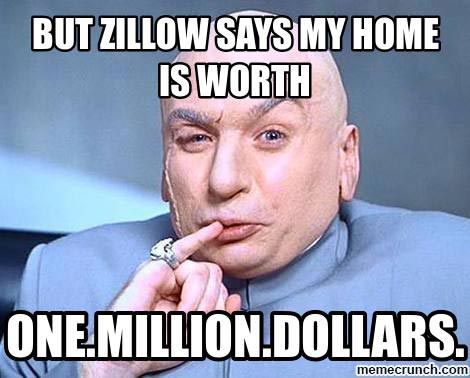
If you’ve ever typed your address into Zillow, Cotality, or one of the dozens of other online home valuation sites, you’ve probably experienced one of two emotions:
- “Wow! I’m rich!”
- “Well, that’s insulting.”
As real estate agents, we see both reactions regularly, and they’re both annoying. I’ve had to talk many sellers down off the “Wow! I’m rich!” ledge when discussing list price.
It’s hard because you certainly don’t want to insult a potential client, but for me personally, I also don’t want to be six months down the road with a listing that would have sold five months earlier if we’d just priced it right to begin with.
I live this experience personally as well. Recently, I listed one of our new-construction homes in Bella Vista, where the online valuation and the actual market value appeared to be living in completely different zip codes.
The funny thing? The comparable sales were crystal clear. The market was speaking. The buyers were speaking.
The algorithm, however, had apparently chosen violence.
Cotality feels strongly that I should have listed this property almost $200K below where we landed. That’s not a slight difference. That’s a whole mortgage difference.
Never mind that our subject property literally backs onto a mountain bike trail, has custom everything throughout, and similar properties are selling for MORE per square foot than ours. None of that matters to a computer-calculated valuation.
Why These Estimates Can Go Sideways
Online valuation tools are a bit like trying to judge a marriage from Facebook posts.
You can gather some information.
But you’re probably missing a lot of the story.
These sites rely on public records, historical data, and mathematical models. They’re not actually walking through your home. They don’t know you remodeled the kitchen, replaced the roof, added a gorgeous deck, or spent six months convincing your husband that the expensive light fixture was “totally worth it.”
The algorithm simply sees numbers.
Real buyers see the house.
The Bella Vista Problem
Bella Vista is actually a great example of why online estimates struggle.
Two homes can have the exact same square footage, same bedroom count, and same year built.
Yet one backs up to a busy road while the other overlooks a golf course.
One has lake views.
One sits next to common property.
One has builder-grade finishes.
One has custom upgrades.
To an algorithm, they may look nearly identical.
To buyers, they’re not even close.
What the MLS Knows
This is where real estate agents earn their keep.
The MLS doesn’t just tell us what homes are listed for.
It tells us what they actually sold for. And that’s the key.
It shows us concessions, seller credits, days on market, price reductions, pending sales, and dozens of details that public websites often don’t capture accurately.
It’s basically the difference between reading the book and skimming the movie review.
The Bathroom Scale Analogy
Think of online home valuations like stepping on a bathroom scale.
It’s a useful data point.
But if you just ate Mexican food, drank three glasses of water, and celebrated your birthday weekend with cake, it might not be telling the whole story.
The same is true for automated home valuations.
They’re a starting point.
Not a pricing strategy.
Finally….
Don’t get me wrong. I use online valuation tools too. They’re fun. They’re convenient. They’re great for satisfying curiosity at 10:30 p.m. when you’re wondering where your neighbor got their listing price for their house, that they should have called you to list, BTW.
But when it’s time to make real financial decisions, nothing replaces a detailed analysis of current MLS data and local market trends.
Because your home’s value shouldn’t be determined by a computer sitting in another state that has never seen your property.
And if an algorithm ever does learn how to accurately price homes in Bella Vista, understand lake views, golf course premiums, trail access, upgrades, buyer psychology, and market timing…
Well, then I’ll probably be looking for a new career.
Until then, I’ll make decisions based on what I see on the MLS.
You should too. If you’re considering selling your house, do yourself and your sanity a favor and call an agent who is well acquainted with your specific area.

