
“Coffee, Whiskey, and the Truth About Real Estate: Why NWA’s Market Is Heating Up in 2025”

I need another cup of coffee before I dive into this.

 Or a glass of whiskey. 

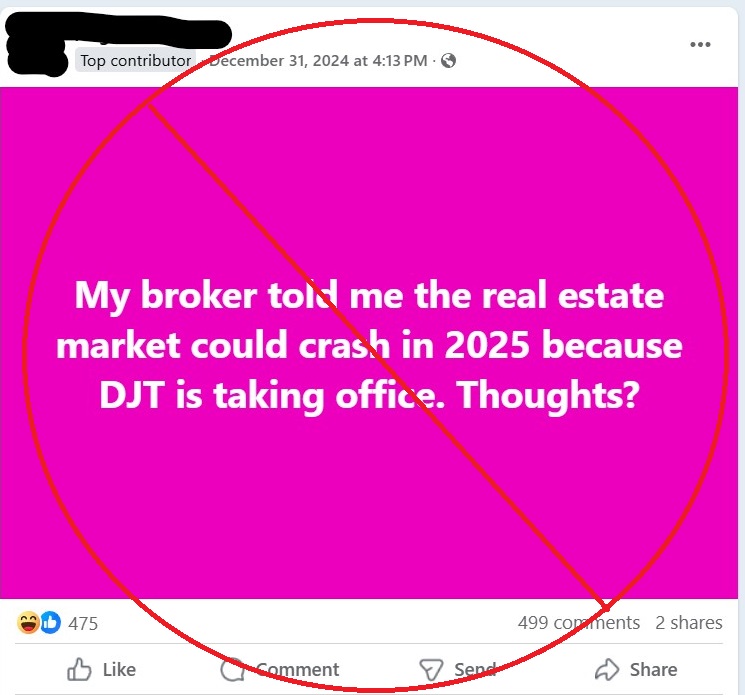
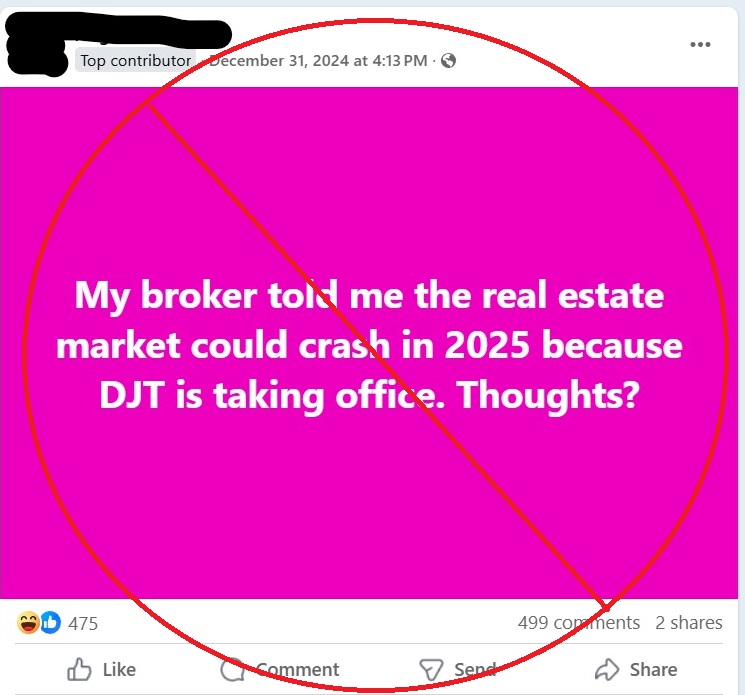
I see posts like this all the time. While they’re most likely meant to grab reactions, they’re a demonstration of ignorance at best. 

I know every real estate market is different. I’ve got my finger on the pulse of both the Austin market and here in Northwest Arkansas. I get it. However, the fact of the matter is that a president, whether Democrat or Republican, will not be able to come in and single-handedly “crash” the real estate market. Wherever you’re at.

Since NWA is my home, I’m going to give you four solid reasons I believe we will see housing prices continue to rise here and why this spring will indeed be a hot market. No matter who you voted for.

But first, let’s talk about how stuff works. 

Yes, I know that a political administration’s policies will affect the market. But I also know how our economy works, as well as the Federal Reserve and their decision on what to do with interest rates, which is what really dictates what happens in all things real estate. 

A quick lesson in how the Fed determines what to do with the interest rate. 

The Federal Reserve does not make arbitrary decisions based on the last election cycle. Decisions regarding whether to lower the interest rate are based on multiple fronts.

  • Inflation: Target inflation rate is 2%. If inflation remains below this rate, this is an indicator rates could drop. Today’s current rate is 2.7%, which is a huge improvement from June of 2022 where it was as high as 9.1%.
  • Employment and labor markets: Higher unemployment rates, slow job creation, and stagnant wages could trigger a rate cut.
  • Economic growth: Slower GDP growth and a drop in consumer spending could signal a cut.
  • Stock market trends: Sharp declines can influence the Fed’s decisions on rate cuts.
  • Global market trends: Global slowdowns can also predict what direction the Feds could take in regard to rate cuts.

…just to name a few. Even natural disasters can affect the decision to raise or lower the interest rates. 

And yes, I know certain policies will affect the market. But please. Stop the fatalism. The sky is not falling, no matter who the president is. 

Now, grab yourself a hot cup of coffee, and let’s go to my four reasons why I believe we’ll see a boon in the NWA market. 

  1. Continued Economic Expansion. Everyone knows Bentonville is the home of Walmart. But did you know J.B. Hunt, Tyson Foods, and Simmons Food all call this area home and continue to attract a skilled workforce? Additionally,  Walmart’s new  1 billion dollar “Home Office” campus, set to open in 2025, is expected to continue to boost local employment and housing demand.
  2. Population Growth: Let’s talk people. Bentonville’s population rose by 2.7% in 2023, and it’s not slowing down. This indicates a sustained demand for housing.
  3.  Limited Housing Inventory: While there’s lots of new construction happening here, housing inventory is still low. This means increased competition for buyers and higher prices. According to the Skyline Report, in the first half of 2024, 4,799 homes were sold in Benton County and nearby areas, marking an 8.5% increase from the previous year, with 39.5% being new constructions.
  4. Stable Mortgage Rates: Finally, future projections indicate that mortgage rates may decline slightly this year, encouraging even more buyers to enter the market and increase housing demand.

Do I have a crystal ball? No. Sure wish I did sometimes, but I don’t need one to determine whether or not the market is going to crash this year. All facts point to a growing real estate economy in 2025.

Similar to my waistline from the holidays. But I digress.

So, to my real estate colleagues, stop worrying, get out there, and sell some houses.

Real Estate Drama: NAR’s Big Settlement Fiasco – Fact vs. Fiction

If you are a real estate agent, buyer, seller, investor, casual perusaler (ok, not a real word) of real estate, or just haven’t had your head under a rock these few months, you’ve seen the big news regarding NAR (National Association of Realtors). Last March, NAR announced that they had reached a settlement agreement to resolve litigation brought by home sellers related to broker commissions. Once that story broke, the media had a field day with misinformation. Agents everywhere began profusely sweating and drinking heavily.  So, facts first:

1. NAR is required to pay out $418 million over the next four years.

2. NAR agreed to create a new MLS rule prohibiting compensation offers on the MLS (Multiple Listing Service). 

3. NAR also agreed to create a new rule requiring MLS participants working with buyers to enter into written agreements with their buyers before the buyer tours a home.

When the news came out, media outlets everywhere began distributing disinformation. Yahoo, NBC, and Joe Biden himself all had something to say, and what they said was largely untrue. 

It was falsely reported that prior to the settlement, real estate commissions were a required and fixed amount of 6%, with 3% going to the listing agent and the additional 3% to the buyer’s agent. Further reporting insinuated that the commissions were legally mandated and set by the National Association of Realtors, the government, or even the Grand Poobah of Greedy Real Estate Professionals Everywhere—whoever that is. 

The truth is that commissions have always been negotiable, not required. Sure, 6% became the industry standard, but it was not the industry requirement. There are many flat-fee agents, brokerages that offer discount services, and even brokerages that specialize in 1% listings.

It has always been well within a home seller’s (or buyer’s) rights to negotiate commission. 

The real problem is crappy agents, specifically listing agents, who do not do a good job of communicating details to their clients. Essential things like how much listing their house is going to cost and the fact that while a listing brokerage may have a standard fee that they charge, those fees are not some mandated amount that can not be negotiated. 

As an agent, disclosure and accounting are part of our fiduciary duties. So, instead of holding those agents responsible for neglecting their fiduciary duties, what was once a pretty transparent process has now been convoluted. 

How? I’m so glad you asked. Let’s compare the new process to the old. Grab yourself another cup of coffee (or a shot of whiskey), and stick with me.

1. Listing process/listing agreement. 

Pre-NAR ruling: When listing a property with a brokerage, you must sign a listing agreement that discloses all the deets and allows that brokerage to sell your property. One of its most important parts is disclosing how that brokerage gets paid. Previously, and depending on your state, that information was a paragraph that included a place for total commission collected at closing and then a place that discloses how that commission might be split between buyers and sellers agents. Again, commissions have, and always have been, negotiable. However, it was typically expected that the seller’s agent would pay the buyer’s agent for bringing a buyer. 

Post NAR ruling: 

Truthfully, we don’t know yet how commissions will be addressed. I believe there will be a place for the listing commission and perhaps another place for the seller to offer a buyer’s agent commission.

Or not.

I assume there will be because the settlement does not say that the seller can’t offer the buyer’s agent a commission. Moreover, the suggested verbiage currently being discussed is about as clear as the congressional budget. 

2. MLS (Mulitple Service Listing rules)

Pre-NAR ruling: Listing agents would list the amount the seller was willing to offer the cooperating broker to bring a buyer. It was typically between 1% and 3%, depending on the NEGOTIATED amount.

Post NAR ruling: Seller agents are now prohibited from disclosing any amount of commission that might be offered to cooperating brokerages on the MLS. That line item will be removed from the listing input completely. 

3. Written buyer agreement.

Pre-NAR ruling: I can’t speak for every agent but I ALWAYS required buyers to sign one of these. A written buyer agreement clarifies the difference between being a customer versus a client and lays out the agent’s and client’s responsibilities. It enables the agent to receive commission and, depending on your state, gives the agent exclusivity with that buyer. Meaning the buyer must use the aforementioned agent to buy a house. Most importantly, at least for me, was protection. If a buyer signs that agreement, it means I have personal information, probably a pre-qual letter from a lender, their driver’s license, and the peace of mind that they’re probably not a serial killer trying to lure me to an abandoned house and murder me.

Post NAR ruling: This is now a requirement for agents working with buyers….which….again…I thought was already a thing. However, the new agreements will include a place for the buyers to check if they are willing to pay their agent’s commission out of pocket if the listing agent doesn’t pay it.

This has led to multiple media outlets, who have no actual idea how this works apparently, to claim the ruling is a win for home sellers and will drive down housing prices as real estate commissions are expected to fall 25-50% 

HAHAHAHAHAHAHA!!!

Right. 

I’d like to see some agents convince their sellers to lower their list price by $10,000-$20,000 or more in some cases since they’re not paying a buyer’s agent. Not gonna happen. 

This ruling and the subsequent garbage analysis being tossed around are doing nothing but confusing people, hurting sellers, and marginalizing certain buyers. 

Think I sound dramatic? Lemme tell you why. First, sellers who believe it will help them financially not to offer a buyer agent a commission will do nothing other than limit their buyer pool. First-time homebuyers, who make up more than 50% of the market, will be disadvantaged. Most have saved up for a down payment, closing costs, and inspection fees. They don’t have the extra $10,000 plus to pay an agent. So those buyers probably aren’t going to come through Mr. Seller’s doors. The house may sit longer on the market, requiring multiple price drops and leaving the seller with less money than if he just offered compensation to the buyer’s agent.

Some first-time homebuyers will also have fewer choices if they don’t have extra money to pay a buyer’s agent and have instructed their agent only to show them properties offering a buyer’s agent commission. Other buyers will lose out on properties in competitive markets. Yet other buyers may find themselves trying to navigate the process on their own, and becoming unfairly taken advantage of.

How many lawsuits will come out of this? 

I’m not a betting woman, but I might take this one. 

Unfortunately, I believe we will see an increase in significant issues in areas that have been unproblematic for years. This NAR ruling forces good agents to walk a very thin tightrope in providing our clients with the fiduciary duties they are sworn to perform as members of the National Association of Realtors.

Stay tuned for some fallout. 

Meanwhile, I intend to continue giving each client my very best.

Just with a little more paperwork and a lot more coffee.